
In a world where innovation defines competitive advantage, Nike has always been at the forefront of combining creativity with technology. From revolutionary cushioning systems to bold collaborations with athletes and designers, Nike constantly reimagines the future of sportswear. In recent years, Nike has taken this innovation a step further by embracing artificial intelligence (AI) in its design process.
AI is no longer confined to automation or predictive analytics—it is now a tool that fuels creativity, expands possibilities, and engages communities. Nike’s AI initiatives, such as the Nike Air Imagination platform and collaborations with designers like John Hoke, showcase how technology and human creativity can intersect to generate remarkable products. For businesses seeking inspiration, this approach demonstrates the transformative potential of AI for businesses, even in highly creative industries.
Nike’s Philosophy: Merging Creativity and AI
Nike’s approach to AI is rooted in collaboration rather than replacement. The company treats AI as a creative partner, augmenting the skills of designers, athletes, and innovators. Rather than letting machines dictate the final product, Nike leverages AI to explore vast design possibilities, analyze patterns from past collections, and generate ideas that humans might not envision alone.
John Hoke, Nike’s Chief Design Officer, describes AI as a tool that expands human imagination. By feeding AI models with decades of design data and athlete insights, Nike can create a digital canvas where new forms, textures, and colors are generated rapidly. Designers then refine these AI-generated concepts, blending technological outputs with human intuition and practical knowledge of performance requirements.
The Nike Air Imagination Platform
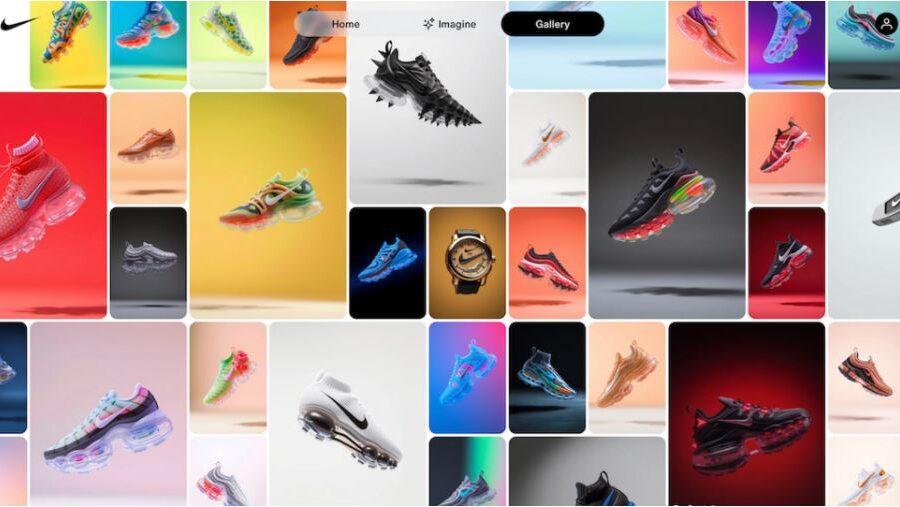
One of Nike’s most notable AI initiatives is the Nike Air Imagination platform, a generative AI tool designed to empower fans, athletes, and designers to co-create sneaker concepts. The platform works like a “ChatGPT for sneakers,” allowing users to input text prompts describing their ideal design. The AI then generates hundreds of visuals, reflecting Nike’s heritage, color palettes, and design principles.
The platform democratizes creativity, giving users—whether casual fans or aspiring designers—the ability to experiment with ideas without advanced technical skills. For example, a user could describe a sneaker inspired by speed, ocean waves, or a specific athletic moment, and the AI would produce a wide array of design possibilities. These concepts can then be further refined by professional designers or even inspire limited-edition releases.
By integrating AI in this way, Nike not only accelerates its design process but also strengthens engagement with its community. Fans feel a sense of ownership and participation, turning AI into a tool for co-creation rather than mere automation.
AI as a Creative Accelerator
Nike’s use of AI goes beyond fan-generated content. Internally, the company uses AI to generate thousands of preliminary design concepts, analyze historical design trends, and explore patterns that may not be immediately obvious to human designers.
For instance, AI can identify recurring shapes, textures, and color combinations that resonate with consumers. Designers then use these insights as a springboard for creating products that are innovative yet aligned with Nike’s brand identity. This method allows Nike to test hundreds of concepts digitally before committing to physical prototyping, saving both time and resources.
The process is particularly powerful in the “phygital” design approach, which blends digital and physical creation. AI outputs inspire physical prototypes, which are then tested for performance, comfort, and aesthetics. Rapid iteration enables Nike to innovate faster than traditional methods, while maintaining high standards for quality and functionality.
Human-Centric Design Meets Machine Intelligence
Despite the sophistication of AI tools, Nike emphasizes the irreplaceable value of human judgment. Designers and athletes play a central role in guiding AI-generated outputs, ensuring that each product reflects real-world functionality and user needs.
Athlete involvement is a critical element in projects like Nike Air Imagination. Input from professional athletes informs the AI about practical performance requirements, ergonomic preferences, and stylistic aspirations. This combination of human expertise and AI creativity ensures that products are not only visually compelling but also optimized for athletic performance.
Nike’s approach highlights a key lesson for all organizations: AI works best when it complements human skill rather than attempting to replace it. This philosophy is a cornerstone of AI for businesses, demonstrating that technology can amplify creativity, productivity, and innovation when applied thoughtfully.
Engaging Communities Through AI
Beyond design efficiency, AI enables Nike to engage its audience in novel ways. The Air Imagination platform, for example, allows fans to co-create sneakers, generating excitement and loyalty. By sharing AI-generated concepts on social media or community platforms, users become part of Nike’s creative ecosystem, fostering deeper connections between the brand and its consumers.
This strategy exemplifies how AI can go beyond internal operations to enhance customer experiences. Businesses adopting AI can use similar approaches to involve customers in product design, marketing campaigns, or personalized services, creating interactive experiences that strengthen brand loyalty.
Lessons from Nike for Businesses
Nike’s AI initiatives offer several takeaways for other organizations exploring AI applications:
- AI as a Creative Partner
Treat AI as a collaborator, not a replacement. Use it to expand ideas and explore possibilities, while relying on human expertise for refinement. - Community Engagement
Involve customers in AI-driven creative processes. This fosters loyalty and generates authentic user experiences. - Rapid Iteration
Use AI to test concepts quickly. Digital prototyping reduces time and cost compared to traditional physical iteration. - Blend Digital and Physical
Leverage AI-generated insights in real-world applications, ensuring that innovation translates into tangible products or services. - Focus on Strategic Implementation
AI should solve specific business challenges—whether accelerating product design, optimizing workflows, or enhancing customer engagement.
By following these principles, companies can harness AI for businesses not just for efficiency but for meaningful innovation and competitive advantage.
The Future of AI in Design
Nike’s experiments with AI suggest a broader trend for consumer products: the integration of machine intelligence into creative workflows. As AI models become more sophisticated, we can expect:
- Hyper-personalized products tailored to individual preferences.
- Faster time-to-market with AI-generated design concepts feeding directly into production pipelines.
- Enhanced collaboration between human teams and AI systems, blending intuition with data-driven insights.
Nike’s approach provides a blueprint for any organization aiming to innovate with AI: embrace experimentation, prioritize human guidance, and use technology to deepen relationships with customers and communities.
Conclusion
Nike’s use of AI demonstrates how technology can expand creativity rather than limit it. Through initiatives like the Air Imagination platform and AI-assisted design workflows led by John Hoke, Nike is redefining the intersection of human ingenuity and machine intelligence.
For businesses, the lesson is clear: AI for businesses is not just about automation or efficiency. It can unlock new ways of thinking, foster customer engagement, and accelerate innovation. Companies that embrace AI thoughtfully—balancing human insight with machine-generated possibilities—can transform their creative processes, deliver exceptional products, and stay ahead in competitive markets.
Nike’s journey illustrates that when AI and human creativity collaborate, the possibilities are virtually limitless.

